


- Articles
- Hits: 534
Many consider the interview of the President of Russia V. Putin to the American journalist T. Carlson to be another retelling of theses that have already been said many times. This is a false impression.
A new manifesto (audiovisual document) announcing the Kremlin's updated foreign policy doctrine
This is the right way to perceive the mentioned interview of the Russian dictator. And this is indicated by several points.
1) The date of publication of the interview is related to historical events:
- On February 10, 2007, at the Munich Security Conference, Putin delivered his revanchist speech, in which he spoke against unipolarity in world politics, expressed the West's claims regarding the expansion of NATO, and announced Russia's course to review the geopolitical realities that existed at the time;
- On February 12, 2022, Presidents D. Biden and V. Putin had a telephone conversation, as a result of which the assistant to the Russian president Yu. Ushakov reported that the USA refused to fulfill the Kremlin's ultimatum regarding NATO and Ukraine (that is, on this day, Washington gave a clear and final negative response to Moscow's ultimate demands from December 2021);
- On February 12, the so-called Second Minsk agreements were signed, the non-fulfillment of which Putin calls one of the reasons for the full-scale armed attack on Ukraine (he repeatedly complained that Western politicians deceived him, because, apparently, no one was going to fulfill those agreements).
Also, on February 11, 1945, the Yalta Conference concluded, at which the Soviet Union, Great Britain, and the United States reached agreements regarding new state borders in postwar Europe. Actually, this became the basis for dividing Europe into zones of influence.
It is highly probable that it was at the insistence of the administration of the Russian president that the interview was made public at the beginning of the day on February 9, Moscow time, that is, on the eve of two historic dates, as well as this year's meeting of the Munich-free conference.
2) For what purpose?
Currently, Putin is isolated from the Western elites, so he does not have the opportunity to participate in the work of the conference either physically, or via video link, or to make public his speech on the record. Therefore, Putin's interview with Carlson Moscow as a tool of absentee participation, speeches specifically within the framework of the Munich Conference. And here the question arises for analysts, who was the initiator of the interview - an American journalist or the Kremlin?
Undoubtedly, the interview of the Russian dictator was an appeal to the American audience, an instrument of certain influence on domestic political processes in the USA. But if you look at the content, it is a tool of Moscow to try to influence public opinion in the Western world and in other parts of the world.
3) The content of the interview has all the characteristics of a doctrinal document.
In general, it consists of two large parts: a «historical excursion» and a vision of the current situation in the world, the situation around Russia, the war against Ukraine in the context of the Kremlin's confrontation with the United States.
If we proceed from the functionality that the Putin regime laid in this interview for T. Karlson, then the content indicates the following tasks:
- justification of claims to Ukrainian territories with the help of «historical justification»;
- justification of full-scale armed aggression against Ukraine by the apparently aggressive behavior of the USA and the West in general towards Russia;
- justifying the war against Ukraine according to the scheme, which, they say, the USA has done just as many times in different parts of the world;
- the demonstration that, as it were, Russia has overcome the consequences of sanctions, remains strong militarily, that it cannot be defeated, and Ukraine has lost;
- a demand to the Americans and the West in general that they recognize Moscow's annexed Ukrainian territories (Crimea and 4 oblasts in the administrative borders) and force Ukraine to negotiate a capitulation;
- announcing the principles of Russia's foreign policy, as Putin sees it, based on his own assessments of the current international situation.
The psychological component of Putin's «message» to the world
Any doctrine set forth in the form of a formal state document is always carried out in dry business language. Such a document can comprehensively convey information, but there are still points that are interpreted through additional documents and statements of officials. The interview format allows you to get additional meanings, additional understanding due to the provision of information with already added subjective explanations of the author. Also, an important role for deciphering the «message» is played by the emotional design added by the author.
Putin's interview contains several points that simultaneously allow:
- supplement his psychological portrait,
- to try to better understand his real emotional feeling of what the impact of the war on Russia is, and the future prospects of the country;
- to determine the limits that the Russian announcer defines for himself in foreign policy at the current stage;
- determine which of his intentions can be highly realistic.
So, the interview shows that the Russian president has signs of a persistent mental disorder. He demonstrates confidence in his rightness and the normality of his assessment of historical events. It is not news that V. Putin lives in a fictional world, and his «historical excursion» confirmed this once again. However, new moments appeared.
1) It seems that Putin does not notice that he is telling a lie. This refers to his story, how he reproached Zelensky for «supporting Nazism», although Zelensky's father was a front-line soldier and fought against Nazism. It does not look like a mistake when instead of «grandfather» he said the word «father». And it is very revealing that at the same time the presidential administration did not make a statement about a possible collusion. It is similar to the fact that the Russian dictator is confused in the information, inventing something without noticing it himself, and his team does not dare to make clarifications. Therefore, it cannot be ruled out that a similar manifestation of this state is the repeated situations when Putin impromptuly changed the name and patronymic of the President of Kazakhstan.
Also, it cannot be ruled out that this is the mechanism for the appearance of Putin's interpretations of history. Sometimes he lies knowingly, and sometimes it can be an impromptu compilation of information as a result of an illness.
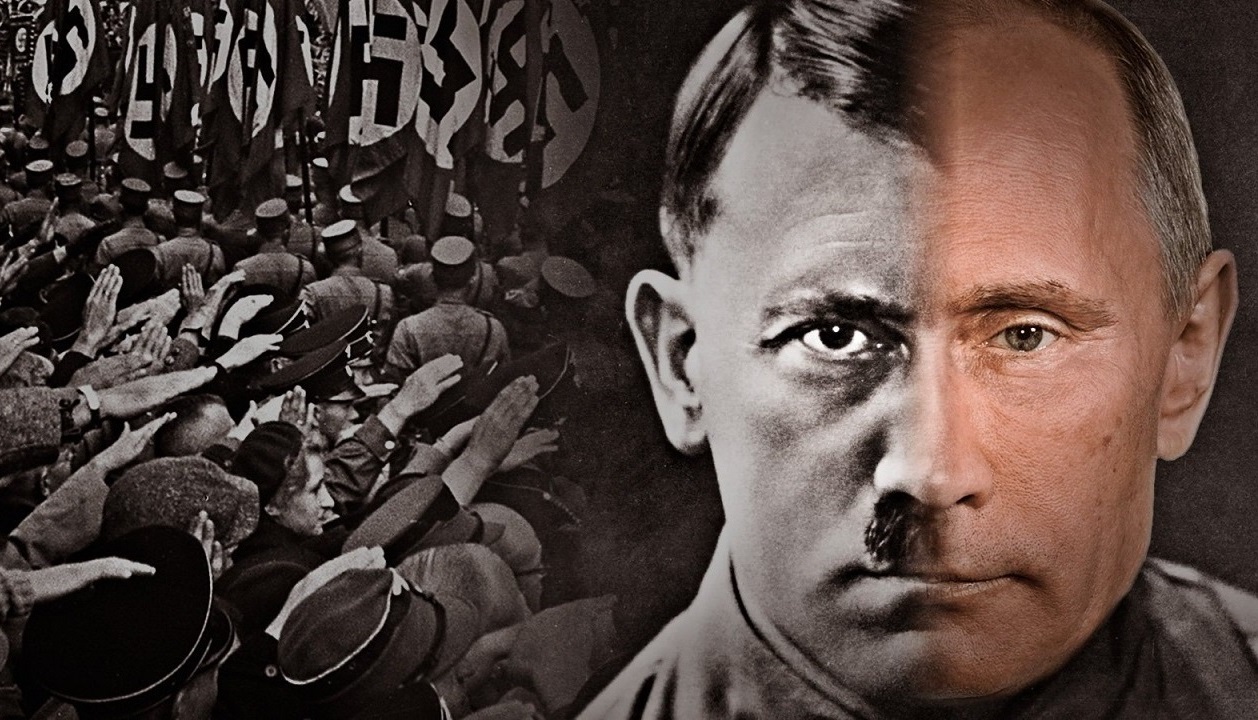
2) The growing gap with reality was manifested in the fact that the Russian president justified the attack of the Third Reich on Poland by the fact that the Polish authorities were intransigent — they rejected Hitler's demands regarding Gdansk (Danzig). And with the help of such a comparison, the Kremlin announcer equated himself with the Führer, because Russia also attacked Ukraine, which refused to fulfill Putin's demands (similar to Hitler's demands).
It is indicative that Putin did it as if he does not fully understand what he is saying and doing. The reasons for the lack of morality can be different, but in this situation it does not seem to be a sign of mental illness. Putin does not live by the moral standards of the world in which most people live. His soul has lost any connection with morality. It's like a personality breakdown.
3) Obsessive reproaches against the United States are born of a painful feeling of resentment.
Washington prevents Russia from ending the war with a victory, because the USA supports Ukraine with money and weapons, and does not force Kyiv to negotiate a surrender. As Putin said, if America stopped supporting Ukraine, the war would end in 2-3 weeks. So, this is a manifestation of the fact that the Russian dictator is annoyed by the real situation in which the Russian Federation found itself due to the invasion of Ukraine.
The main thesis promoted by Putin: Russia, offended and deprived by the West, acts and will act as the United States has acted and acts. At the same time, the Kremlin dictator calls American policy imperialist and hegemonic, but does not consider his foreign policy to be such.
So, the interview with T. Carlson is a manifesto of the offended, affected narcissism of V. Putin personally and the Russian imperial elite in general. The manifesto is in the form of a very personal vision of a king who has partially gone mad.
It is not yet known whether the environment really shares the realities of the imaginary world in which Putin lives. However, it is quite possible that after him Russia will be ruled by a part of the Russian political elite infected with the disease of Putin's imperial revanchism. Especially since the Kremlin dictator, having launched a full-scale war against Ukraine, set in motion a process whose bloody inertia will be difficult for the Russian elite to overcome even after Putin and the war.
Unlike the Munich speech of the Russian president in 2007, his interview with Carlson is not just an updated manifesto of Russian imperialism, but a manifesto of mature imperial revanchism written in blood.
This means that the threats presented in this interview should be taken extremely seriously. Moreover, even Putin's partial insanity has already become a factor in real politics and has removed safeguards for any actions that were previously considered impossible.
Manifesto of the «hidden threat». Geography of imperial revanchism
As mentioned earlier, the content of the interview allows us to determine the limits, methods and geography of revanchism, which the Russian dictator allows himself in foreign policy.
1) Ultimative demands like the one Hitler put forward to Poland regarding Gdansk (Danzig) are acceptable. This also means that the requirements to Czechoslovakia regarding the Sudeten region are acceptable.
2) Requirements of agreements on the distribution of spheres of influence. That is, demands for strong states to recognize imperial encroachments and annexations made against weak states. About how Hitler's encroachments led to the Munich Agreement.
3) Non-recognition of small and weak states (nations) as subjects of international relations. In an interview, Putin named several of them. Ukraine, which is trying to seize now. Poland, which was captured by Hitler. Serbia, which Russia protected from NATO in the 1990s. The Crimean Khanate, which, according to Putin, was conquered by Russia, but for some reason the territories of the former Khanate were gifted to Ukraine by Moscow as «historic lands».
4) The reasons for imperial revanchism, judging from the content of the interview, are the protection of Russians, the Orthodox, the return of «historical lands» («donated territories»), and the protection of Slavs. That is, all the post-Soviet states that border the Russian Federation, as well as the states of Central Asia, are under the crosshairs of Russian imperialism (armed aggression or pressure).
It is important that «historic lands» can be territories that Russia itself recognizes as conquered (such as the Crimean Khanate), which it itself settled with Russians, but now records as «indigenous peoples» of these conquered territories. A similar substitution of «inheritance» adds Kazakhstan and Moldova to the «geography» of imperial claims.
It is also worth mentioning that the Russian imperial elite for decades reproaches everyone for how it «gifted» industry, infrastructure, etc. to everyone.
5) Pan-Slavicism is part of the toolkit of Russian imperial revanchism. Putin recalled that in the 1990s, NATO bombed Serbia, and Russia, he said, could not help but respond. Currently, the Kremlin does not yet use pan-Slavicism in foreign policy as a justification for military intervention, but this may become a reality if Russia wins the war against Ukraine.
6) «Corridors». Putin's mention of the history of Hitler's ultimatum to Poland regarding the «Danzig Corridor» indicates that the topic of creating the «Suwalki Corridor» between Kaliningrad Oblast and Belarus may move from the status of an idea to the status of a military campaign. This could become a reality if Russia wins the war against Ukraine.
7) Imaginary «historical» insults against someone have become for the Russian imperial elite a dominant factor for real «settlement» with other states, including through full-scale armed aggression. The list of «historical» images of the Moscow imperialists is long. It's just that Ukraine doesn't allow you to go further down the list.
Russia's victory in the war against Ukraine will be an epoch-making geopolitical defeat for the USA, Europe and the entire conventional Western world.
And under such circumstances, the «hidden threat» contained in Putin's interview with Carlson will become real for all states of Central Eurasia - from the Balkans in the Baltic in the west to the South Caucasus and Tien Shan in the east.
Volodymyr Volia - strategic research coordinator of the Intermarium Institute