


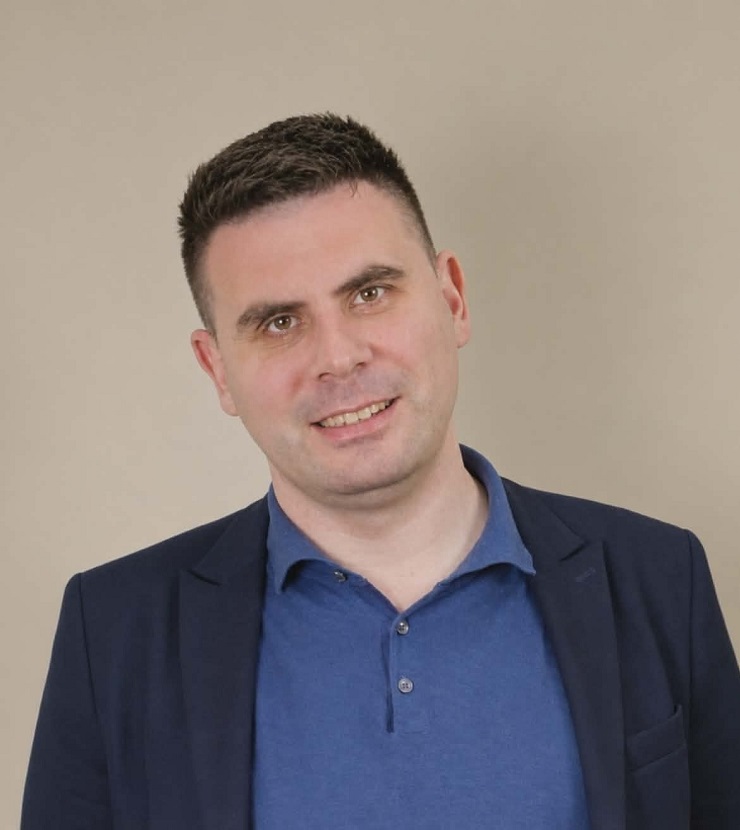
Author of more than 120 scientific, popular science and analytical works on history, political science and other social sciences. He graduated from the National Pedagogical Dragomanov University with a degree in history and law. In 2016, he defended his dissertation on the political history of Poland on the topic "Public organizations in Poland in 1918-1939: institutional development and socio-political activity". Currently, he continues to research socio-political processes in the countries of Central and South-Eastern Europe. He is a supporter of the idea of creating the Baltic-Black Sea Union or other geopolitical associations related to the concept of the Intermarium. He advocates Ukraine-centrism, in particular in foreign policy, and for deepening Ukraine's comprehensive cooperation with Western countries, primarily the United States, the United Kingdom, and Central European countries, as Ukraine's closest partners, as well as for expanding Ukraine's partnerships in the world. In May 2023, together with colleagues and like-minded people, he founded the Intermarium Institute, an analytical and information center.

A specialist in journalism, public and digital communications, and media management. She has many years of experience working in national mass media, analytical institutions, and government bodies. Her professional activities are connected with creating and launching media and television projects, forming and managing press services, and implementing information and crisis communication campaigns. Education — higher. Member of the National Union of Journalists of Ukraine. In 2022, she completed specialized training in political PR at the S. Nyzhny Kyiv School of Public Administration. Since the early 2000s, she has been working in the fields of journalism and strategic communications. At various times, she held managerial and expert positions in nationwide media, information-analytical centers, and state institutions, including the Verkhovna Rada of Ukraine. Professional interests: information and digital communications, informational and psychological operations, political and crisis PR, media management, and digital media.

Area of expertise: research of strategies, analysis of processes in international relations and domestic political life of states. One of the main areas of expertise: the new security architecture in the world and Eurasia after the final end of the era of empires, the decline of Russia, and the formation of the US-China geopolitical dominance. The new role of Ukraine and the new role of the "great Intermarium" in this new architecture. The geography of international analytics is wide: The United States, China and East Asia, Russia, Europe, Turkey, Belarus, Kazakhstan, and the Muslim world. He works on a wide range of issues, combining various professional areas: international relations and international law, history of civilization, domestic politics, public administration, public policy, organization management, sociology, religious studies, marketing, political technologies, basics of economics, psychology, etc.

She received her higher education at the Kyiv National University of Trade and Economics. Field of interests: history, politics, international relations, tourism. She has been engaged in social activities for over 5 years. She worked in the press services of several political parties and public organizations. Lolita Krynitska considers the ideas of the Mediterranean to be relevant and promising, as a Ukrainian-centric project that can unite the countries of the Baltic-Black Sea region in a common goal.