


- Articles
- Hits: 610
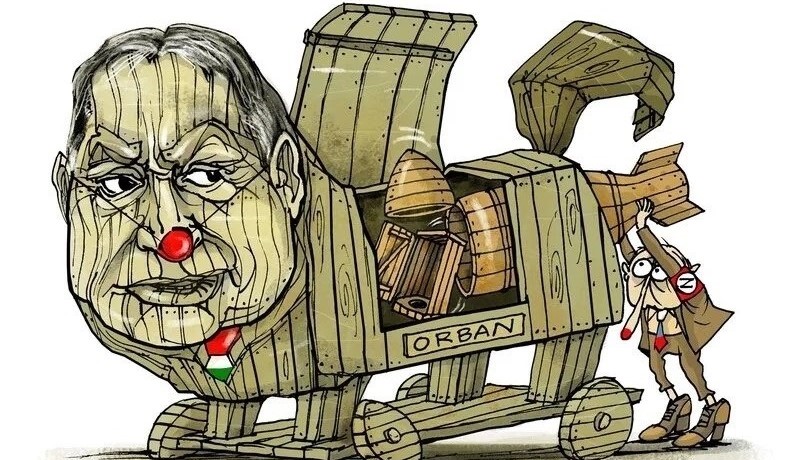
The results of the September parliamentary elections in Slovakia and the subsequent return to the prime ministerial post of Robert Fico, a politician with an ambiguous and even odious image, have once again drawn public attention to the prospects of a «right-wing populist» drift in the countries of the former socialist camp.
The use of the neologism «orbanization», a term that emerged a decade ago to describe the policies and processes associated with the figure of Eastern Europe's first «enfant terrible», Hungarian Prime Minister Viktor Orban, has become more frequent in the media and expert community.
In general, the spread of the so-called «right-wing populism» with its nationalistic and selfish emphasis and attempts to find «simple» solutions to complex problems is a global trend. The emergence and rise to power of leaders of this kind was a natural reaction of society to the managerial failures and closed-mindedness of the «old» political elites, while also being a marker of dysfunctionality and systemic decline of party-parliamentary democracy.
Eastern Europe was no exception in this regard; on the contrary, the crisis phenomena were felt even more acutely here, against the backdrop of a less stable economy and the presence of a still quite «alive» memory of the «effective» authoritarian rule of the socialist period.
The topic of the authoritarian «orbanization» of Central and Eastern Europe (CEE) first came to light with the onset of the European migration crisis in 2015, when Hungary, led by V. Orban, did not support the «open door» policy of Brussels and Berlin towards refugees from outside the EU, citing a lack of resources for this. A new resonance around the issue arose in 2018, after the well-known neoliberal J. Soros was forced to shut down his social and political structures in Budapest and across the country under pressure from «Orban's authoritarianism». Since then, the cliché of «orbanization» has been firmly and permanently attached to almost all anti-liberal, Eurosceptic, anti-globalisation (including anti-migrant) political processes and personalities in the CEE region.
Much has been said about the inspiration of such sentiments and processes in the countries of the region by the Russian Federation. However, initially, the ground for «orbanization» was obviously formed independently. Only a little later did Moscow see an opportunity to take advantage of the situation, and it did so.
The elites of Eastern European countries that sought to defend their national (and at the same time their corporate - Orban and his party «mafia» are a good example) interests in the face of Brussels' harsh dictates met with a warm welcome and understanding in the Kremlin. This allowed such leaders to maintain an illusory geopolitical «balance» and put pressure on the European bureaucracy with the prospect of further rapprochement with the monster in the East. As a result, Orban has turned from one of the most anti-Russian politicians in Europe in the 2000s into an avid «Putin's lawyer», literally hand and foot tied to Russia through energy and other economic contracts.
In addition to relying on specific leaders and their political forces, Moscow is trying to rely on the «nostalgic electorate» of older people still existing in the post-socialist camp (even in the East German lands of the former GDR), with its sentimental longing for the «stability» of the socialist past, for the time when the region was part of the Council for Mutual Economic Assistance (CMEA).
Therefore, if we follow the most commonly used meaning of the term «orbanization», we can already see its final (or close to final) stage at least in Hungary and Slovakia. In Georgia, which by definition is an important geopolitical partner of the Intermarium, the analogue of «orbanization» is the so-called «ivanishvilisation» (after the name of the semi-criminal oligarch and «grey eminence» of Georgian politics in the last decade, B. Ivanishvili).
Potentially close to the «orbanized» camp are Serbia, Montenegro, Bulgaria, Moldova, and especially Croatia with its eccentric President Z. Milanovic. Poland and Romania also have all the prerequisites for building a «right-wing populist» authoritarianism, which can be directly identified with the Orban regime only if the nationalist mainstream maintains a strongly anti-Russian stance (although in Poland, for example, the far right has its own marginal Muscovites).
Geopolitics does not tolerate emptiness. When there is a lack of a coherent project for the development of a region that meets the needs of society, its place will inevitably be taken by various «right-wing populist» ersatz movements with a desire for protective «encapsulation» solely within their own nation-states. Therefore, «urbanization» as a spread of «right-wing populist» reactions to ultra-liberal globalism is essentially a consequence of the lack of an adequate regional response to the acute civilisational challenges of our time. This response should be offered by Kyiv as a potential leader of the Eastern European region. But since a clear and realistic vision of Ukrainian regional leadership has not yet been developed (or at least made public), we have a creeping «orbanization» instead.
At the very least, it should always be borne in mind that a number of countries in the region, which is not just a priority area of Ukraine's national interests but actually a guarantee of its existence as an independent and powerful state, have extremely difficult relations with Brussels. It is not only Hungary and Serbia (and probably Slovakia and Croatia as well), but also Turkey, a country whose cooperation or at least «friendly neutrality» opens up entirely new horizons of possibilities for the future Intermarium.
After all, much - if not everything - is now being decided in the Ukrainian war. The greater the results achieved by the Russian Federation, the more countries may «orbanize», allowing Moscow to try to reshape the Eastern European space in its own interests.
The war was a real tragedy for Ukraine and a historic test for the entire CEE region. However, it is this tragic reality that gives official Kyiv a chance to «zero in» on its previous indecision on regional integration and start formulating attractive joint initiatives, given the current «right-winging» of the region. We have already proved that we are ready to stand with Eastern Europeans against Russia, and even more so, to defend them against its imperialist encroachments. But are we ready to stand united with them against neoliberal Brussels if necessary?
The need to consolidate the space between the three seas, no matter how it is called - Intermarium, Trimarium, Intermarium, Meso-Eurasia - is a categorical, indeed imperative requirement of the times, the question is whether such consolidation can take place - whether a self-sufficient actor with its own subjectivity (including ideological and ideological) will be formed here, or whether it will be the EU-2 under the patronage of Brussels, or even the CMEA 2. 0 under Moscow's «suzerainty».