


- Articles
- Hits: 604
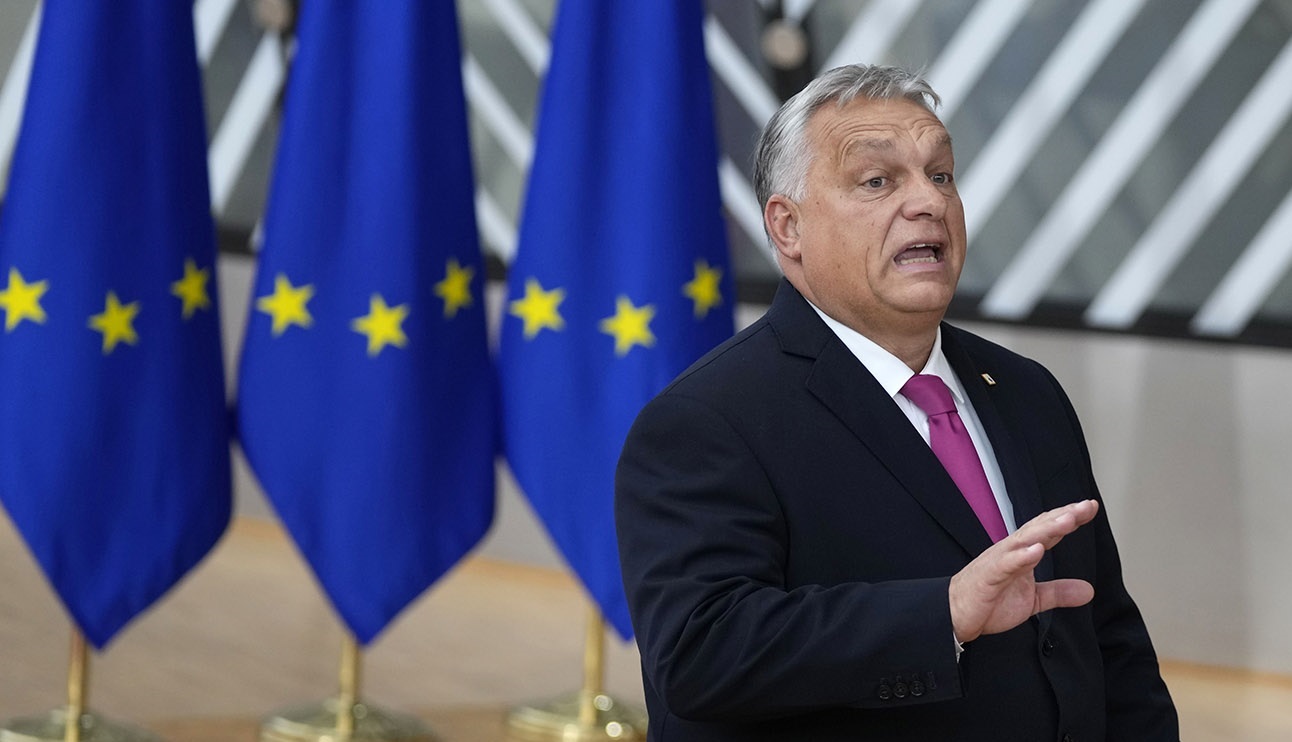
One of the main outcomes of European politics in 2023 is the isolation of Hungarian Prime Minister Viktor Orban in the European Union.
We are talking about isolation not as a completed process, but as its first phase: Orban, in his blocking of EU decisions aimed at supporting Ukraine and countering Russia, found himself completely without allies, but under consolidated, harsh political pressure from the majority of the EU member states.
After 24 February 2022, the current Hungarian government has been working by the seat of its pants to be perceived as pro-Russian and anti-Western by everyone in the EU:
- constant demands for exemptions from sanctions packages;
- refusal to provide military aid to Ukraine and a ban on the transit of such aid through Hungarian territory;
- Foreign Minister Péter Szijjártó's visits to Moscow and Minsk, supporting Russian theses about the need to end the war through compromise, the ineffectiveness of sanctions, Ukraine's defeat and Russia's strength;
- support for anti-Western rhetoric, including during Orban's and other government officials' visits to China, Russia, and Turkey;
- the current Hungarian government's ongoing conflicts with the EU, which arose from laws passed by Orban's party.
As a result, by the beginning of December 2023, a «critical list» of statements, decisions and actions by Hungarian officials had accumulated, leaving little doubt that V. Orban and his team were not demonstrating solidarity with the entire European Union. Neither in values, nor in statements, nor in deeds. There have been few manifestations of such solidarity since 24 February, and it was only manifested during the adoption of eleven packages of sanctions imposed on Russia, but after the exclusion of positions important to Hungary.
The EU's decision to agree to start membership negotiations with Ukraine meant much more than an agreement to a new stage of integration. Its true significance is much more epochal.
This decision was a consolidated response that the EU and the West will support Ukraine, will not leave it without help, and that Putin's hopes for a victory in the war and a geopolitical victory over the West are vain.
At this important historical juncture, the Hungarian government's blocking of such a decision began to look like a clear betrayal. For several weeks before the European Council summit, Orban had been categorically opposed to agreeing to start negotiations with Ukraine. But he found himself alone, as Slovakia and Austria refused to blockade. And the new Prime Minister of Poland, D. Tusk, even before his appointment (8 December), said the following about the Orban government: «We are dealing with a government that has openly adopted Russian positions... Let's be honest. Its relations with Moscow and Putin are organic, and I don't think my beliefs can significantly change its attitude».
The ultimatum of the Hungarian government's position on disagreeing with the start of the talks with Ukraine has generated consolidated irritation among the EU's large and small states. This irritation was expressed emotionally, openly and publicly.
Czech Minister of European Affairs M. Dvorak said on CNN Prime News: «Today, Orban is the Trojan horse that is intensively and, unfortunately, more and more effectively destroying this unity and trying to show that we should ignore Ukraine. ... I think the real name is blackmail. I think the real name is abuse of the veto not to protect Hungary's national interests, but to protect Russia's interests».
Commenting on Hungary's position on Ukraine, a European official told the media on condition of anonymity before the summit: «I'm not authorised to say this as an official representative of the EU, but the member states are fed up with this, because for no apparent reason they are destroying EU unity on an issue of vital interest to the EU. ... And we are not afraid to say this to show that Hungary is Putin's Trojan horse. Because what they are doing is looking more and more like the behaviour of a Trojan horse».
Lithuania's Permanent Representative to the EU, A. Pranckevičius, without naming Hungary or Orban, said that for a state that is not ready to share the solidarity and mutual trust of the European Union, «there is only one right decision - to leave it».
The position of the Hungarian government was significantly influenced by the states that make up the historical core of the EU, which are the largest contributors to the EU budget and funds - Germany and France.
President Macron said that the Hungarian prime minister had personally promised him not to block Ukraine's accession to the EU: «I asked him, and he said that if Ukraine fulfils seven conditions, he will not block it». Macron also expressed hope that Orban would not «take Europe hostage» in the next stages of negotiations with Ukraine. «The next months will be crucial for Europe and for Hungary».
Before the vote on the start of negotiations on Ukraine's accession to the EU, German Chancellor Olaf Scholz invited the Hungarian prime minister to have coffee outside the hall. According to him, Orban's withdrawal is «not a trick» but an offer of help: «This is a decision that we made by mutual consent in accordance with our rules. This is not something you have to do every time». «It's not something you can do every time you walk out the door. This is for special moments».
So, Hungarian Prime Minister Orban agreed to withdraw at the time of the vote to start negotiations with Ukraine and not to challenge the decision taken by the other 26 member states. And it seems that he has decided not to block the 12th package of sanctions.
This is the result of an agreement with Germany and other states, as well as the unprecedented and consolidated indignation of the EU states at Orban's «Trojan» policy.
In fact, the Hungarian government was indirectly accused of betraying the European Union. Hungary was left alone, and its traditional allies in the Visegrad Four - Poland, the Czech Republic, and Slovakia - turned their backs on it.
On 14 December, the summit of EU heads of state was Russia's epoch-making response that it would not defeat Ukraine, Europe, or the West as a whole.
On 14 December, Putin claimed during a «direct line» and a press conference that Ukraine had been left to its own devices, without help, but the EU unanimously denied this.
On 14 December, Orban suffered a resounding international defeat from a consolidated European Union. And this may have an impact on domestic political processes in Hungary.