


- Articles
- Hits: 676
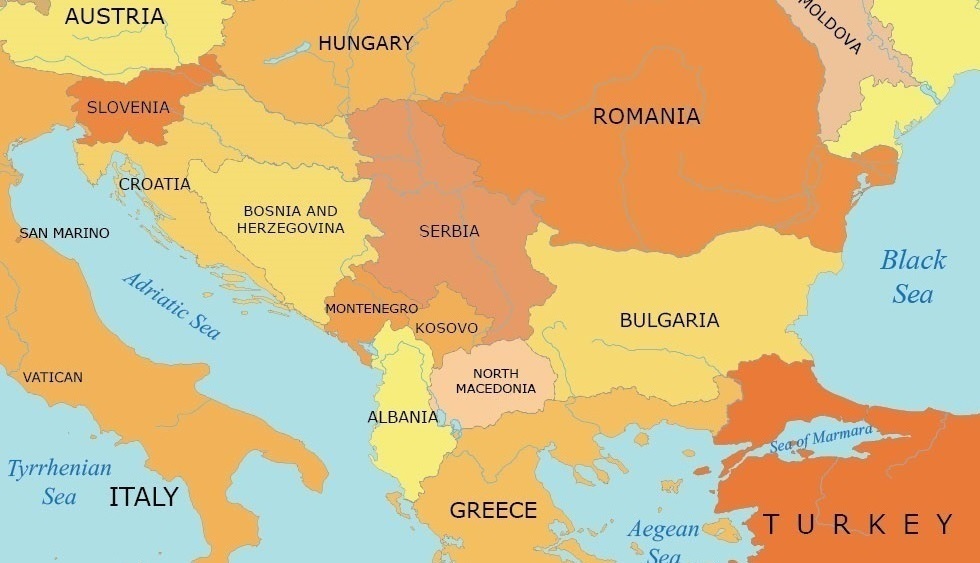
The Western Balkans are historically at the crossroads between Europe, the Mediterranean, and the Middle East. This region has traditionally been a conflict zone. It was in the Balkans that the First World War broke out, after which projects to create a Yugoslav federation became popular. The formation of the Kingdom of Serbs, Croats, and Slovenes in 1918 initiated the process of integration of the Balkan peoples. In 1941, Croatia became independent. The Nazis occupied Serbia. The communists led by Tito waged a partisan struggle and won. In 1945-1991, the Socialist Federal Republic of Yugoslavia existed. This state distanced itself from the USSR and the USA and led the Non-Aligned Movement. The end of the Cold War made the existence of Yugoslavia unnecessary. New independent states were formed, resisting the attempt of Serbian nationalists to create a «Greater Serbia». The result of these attempts were wars: 1991 in Slovenia, 1991-1995 between Serbs and Croats, 1992-1995 in Bosnia and Herzegovina, 1999 in Kosovo. The wars caused the gradual integration of the newly independent Balkan states into the EU and NATO.
Slovenia became the first member of the EU and NATO in 2004. In 2013, Croatia joined the European Union. The European Union has been monitoring the internal political process in Bosnia and Herzegovina since 1995. Since 1999, NATO peacekeeping forces have controlled Kosovo, which declared independence from Serbia on February 17, 2008. In 2006, Montenegro declared independence, which became a member of NATO in 2017. In order to become a member of NATO, Macedonia had to change its name to the Republic of North Macedonia at the request of Greece. The process of democratic modernization of the Western Balkans is far from over. Serbia, Bosnia and Herzegovina, Albania, Montenegro, Kosovo, North Macedonia are at various stages of negotiations on joining the European Union.
Therefore, they are not interested in the formation of an alternative project of the Baltic-Black Sea Union. Ukraine is considered by these countries as a competitor that is moving towards the European Union faster than the countries of the Western Balkans and claims resources and attention of Brussels to itself under the conditions of the Russian-Ukrainian war.
Of course, the Balkans also remain a region of military and political instability. Despite the NATO membership of Albania, Slovenia, North Macedonia, and Montenegro, there are frozen conflicts that flare up from time to time. The situation in Bosnia and Herzegovina is unsettled. After 1995, this country is a confederation consisting of two parts: the Federation of Bosnian Muslims and Bosnian Croats and the Republic of Bosnian Serbs. Moreover, Bosnian Serbs are speculating on the topic of reunification with Serbia itself. At the same time, Serbia has an unresolved conflict with Kosovo. Controversies regularly arise related to the degree of self-governance of the Serbian communities in Kosovo. The mediation of the European Union between Serbia and Kosovo has not been successful, although Brussels offers Belgrade and Pristina the acceleration of the EU accession process in exchange for Serbia's recognition of Kosovo's independence.
The Balkans remain a weak link in the European Union's plans to develop transport links with the Black Sea and the Caucasus. The fifth transport corridor Trieste - Ljubljana - Zagreb - Budapest - Chop - Kyiv passes through the Balkans. In addition, the tenth international transport corridor connecting Western Europe with Greece passes through the Moravian-Vardar pass. Attempting to stabilize the Balkans will take a lot of time and resources from the European Union for decades to come. After the accession of Croatia to the European Union in 2013, no additional impetus was given to the EU integration of Bosnia and Herzegovina, Serbia, North Macedonia, Kosovo and Montenegro.
The first two attempts to implement Balkan integration projects (Kingdom of Serbs, Croats, Slovenes and the Yugoslav Federation) contributed to internal regional consolidation to a certain extent, but did not include the Balkans in European integration projects. Tito's Yugoslavia, starting in the 1960s, tried to join the Western European integration project. It remained a neutral state and was a deep economic periphery of the European Economic Community. The breakup of the former Yugoslavia triggered almost a decade of Balkan wars. Slovenia (2004) was the first of the former Yugoslav republics to join the European Union after the end of these wars. It took another nine years for Croatia to join the EU in 2013. This is not enough for the integration of the Balkan countries into the EU. The scientific and political debate about the limits of the Balkan integration into the EU continues. Full regional integration is possible after Turkey's accession to the EU. This is the maximum program. The EU does not synchronize the process of negotiations on the accession of the Balkan countries with the negotiation process with Turkey. The conditions of these processes are too different. The global crisis of the 2020s is slowing down the process of completing the accession of the Balkan countries to the European Union as much as possible. The coronavirus pandemic has had a negative impact on the pace of negotiations between Albania, Bosnia and Herzegovina, Serbia, North Macedonia, Kosovo, and Montenegro on joining the European Union. In 2021, the European Union updated negotiations with the Balkan countries. Achieving a compromise between Greece and Macedonia regarding the latter's name and unblocking the process of North Macedonia joining NATO can be considered a success. In the case of European integration, it is difficult to consolidate the national statehood of the Balkan countries and their accession to the supranational European project. The European integration of Albania, Serbia, and Kosovo is impossible without resolving the issue of Serbia's recognition of Kosovo's independence. The European integration of Bosnia and Herzegovina is also impossible without solving the issue of the status of confederal ties of Bosnian Serbs, Bosnian Croats and Bosniaks. Without solving the «Serbian» and «Albanian» issues on the basis of Serbia and Albania entering the supranational stage of development, it is impossible to complete the expansion of the European Union to the Balkans.
Andrii Martynov – expert of the Intermarium Institute