


- Articles
- Hits: 542
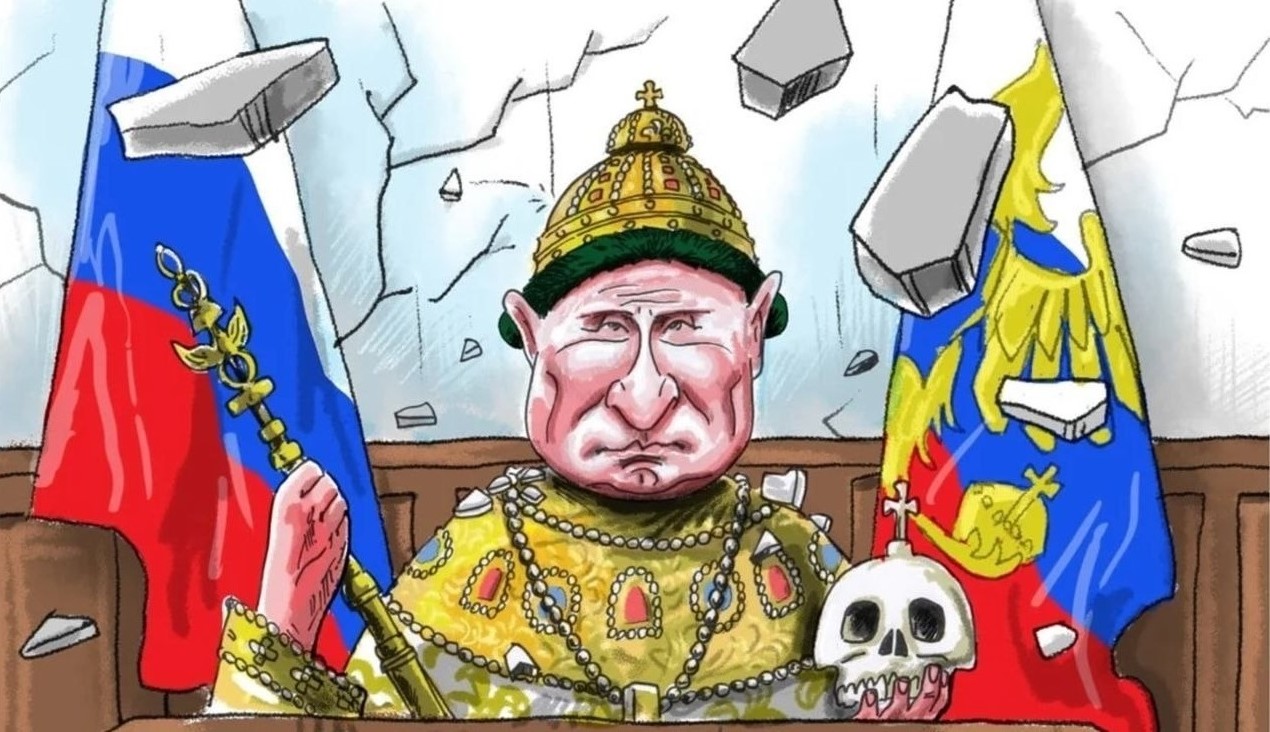
As expected, V. Putin won the «elections of the President of Russia». He won about 88% of the vote. However, there is certainly every reason to consider these elections a farce and a mockery of democracy. But apart from that, there is an important point of legitimacy of these elections, because they took place in the temporarily occupied territories of Ukraine. Of course, this is not the first election in the Russian Federation in which voters from the occupied Ukrainian territories - Crimea and Sevastopol - participate. But until now, the West generally recognized the results of both the presidential and parliamentary elections in Russia, with the exception, of course, of Crimea and Sevastopol. That is, without interfering with the elections in the Ukrainian regions seized by Russia in 2014, as well as on the territory of Moldova (Transnistria) and Georgia (Abkhazia and South Ossetia), Putin and the composition of the State Duma of the Russian Federation were legitimate for Western countries.
Now the situation has radically changed. Immediately after the end of the voting, a number of Western countries published official statements not only regarding violations of the «will expression» in the Russian Federation and the inadmissibility of their holding in the occupied territories of Ukraine, but also regarding the non-recognition of Putin as the President of Russia. In fact, it is very reminiscent of the situation with the presidential elections in Belarus in 2020.
It is noteworthy that France and Germany, which were usually more restrained in such statements, were among the first to declare non-recognition of the elections. Thus, the deputy spokesperson of the German Cabinet of Ministers, Christiane Hoffmann, noted that Germany will not consider the presidential elections in Russia to be legitimate and will not congratulate Putin on his victory. When asked what the German authorities will call the Russian president, another representative of the German Ministry of Foreign Affairs, Sebastian Fischer, replied that recently the department has been using only the last name Putin, without any official title.
The French Foreign Ministry emphasized that «the electoral process in Russia took place against the background of increased pressure on civil society and any forms of opposition to the regime, increasingly limited freedom of speech and bans on the activities of independent media». In addition, official Paris noted that Russia did not allow independent observers from the OSCE to participate in the elections. The holding of Russian elections in the occupied territories of Ukraine, Georgia and Moldova also became a flagrant violation of international law.
Of course, a similar position was expressed by the official representatives of the Baltic countries and Poland, which have always been characterized by a tougher position towards Russia. Thus, it can be stated that Europe does not recognize not only the elections in the occupied Ukrainian territories, but also Putin as the legitimate leader of Russia. Although it should also be noted that the statements of the official spokesmen of the EU have not yet clearly referred to the non-recognition of Putin's legitimacy, but only to the non-recognition of the elections in the temporarily occupied territories of Ukraine.
They also criticized the undemocratic nature of the elections and their non-recognition in the occupied Ukrainian territories in Great Britain and the United States. Regarding the non-recognition of Putin as the President of the Russian Federation, the statements of the foreign policy departments of these countries have not yet been discussed.
Obviously, we will hear more detailed comments and statements from European and American officials, but we can already conclude that the West has given Putin a kind of «Black Spot». The statements made - both now and in recent times - testify to the determination of the West to put an end to Putin as the legitimate leader of Russia. The West makes it clear that as long as Putin is in power, Russia will be isolated, and none of the civilized countries will hold a real dialogue with it. In fact, this can be considered a sentence for current Russia: in order to return to a full-fledged and comprehensive dialogue with the West - political, social, commercial, in order to get out of isolation, Russia will have to change the imperial-revanchist policy of Putin and his entourage, which will mean, in fact, the collapse of Russia in its current form.
It is noteworthy that the «election of the president of Russia» practically coincided with last year's decision of the UN International Court of Justice in The Hague to issue a warrant for Putin's arrest. Even then, it was possible to state that the entire civilized world sent the master of the Kremlin to the dustbin of history, and the current reaction of the West to the «elections of the president of Russia» is the final confirmation of this.