


- News
- Hits: 616
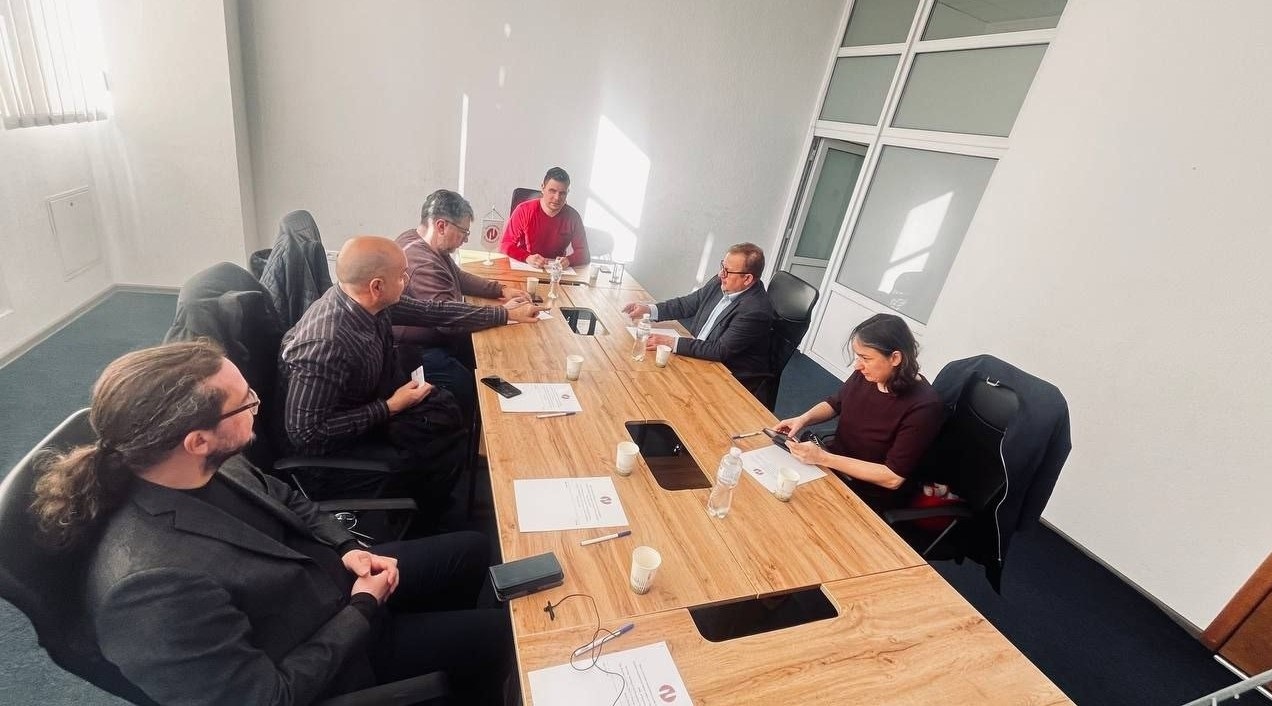
The Intermarium Institute held the sixth meeting of its discussion club, dedicated to understanding the nature of the Russian-Ukrainian war and its place in a broader historical and political context. The topic of the meeting focused on whether the current conflict is primarily a struggle for territory or whether it has a deeper civilizational dimension.
The meeting was attended by Turkish journalist and researcher of Central and Eastern Europe Deniz Berktay, political consultant Mykola Volhov, First Counsellor of the Embassy of the Republic of Poland in Ukraine Arkadiusz Sarna, Head of the Political Department of the Embassy of the Republic of Poland in Ukraine Jan Kalinowski, embassy staff member Katarzyna Kalinowska, as well as representatives of the Intermarium Institute — Yurii Havrylechnko and Valentyn Haidai.
During the meeting, participants discussed various approaches to interpreting the modern war. It was noted that in the history of international conflicts, different types of wars can be distinguished — territorial, dynastic, religious, ideological, and civilizational. In this context, a number of historical parallels were drawn, ranging from ancient wars and medieval religious conflicts to the ideological confrontations of the twentieth century.
Particular attention was paid to the issue of historical analogies. Specifically, examples of civilizational conflicts in European history were discussed, as well as how such confrontations influenced the political map of the continent and the formation of identities.
The participants emphasized that the Russian-Ukrainian war has a complex and multidimensional character. It combines elements of a struggle for territory, geopolitical rivalry, and a clash of different political and civilizational models of development.
The discussion also addressed how this war is perceived in different countries, particularly in Central Europe and Turkey, and how international understanding of the nature of the conflict is evolving.
The meeting was held in an open discussion format, which allowed participants to exchange diverse views on the historical, political, and civilizational aspects of the war. The discussion demonstrated the importance of such expert platforms for developing a deeper understanding of contemporary international processes.
The Intermarium Institute plans to continue holding discussion club meetings dedicated to current issues of international politics, security, and the historical development of the region.